
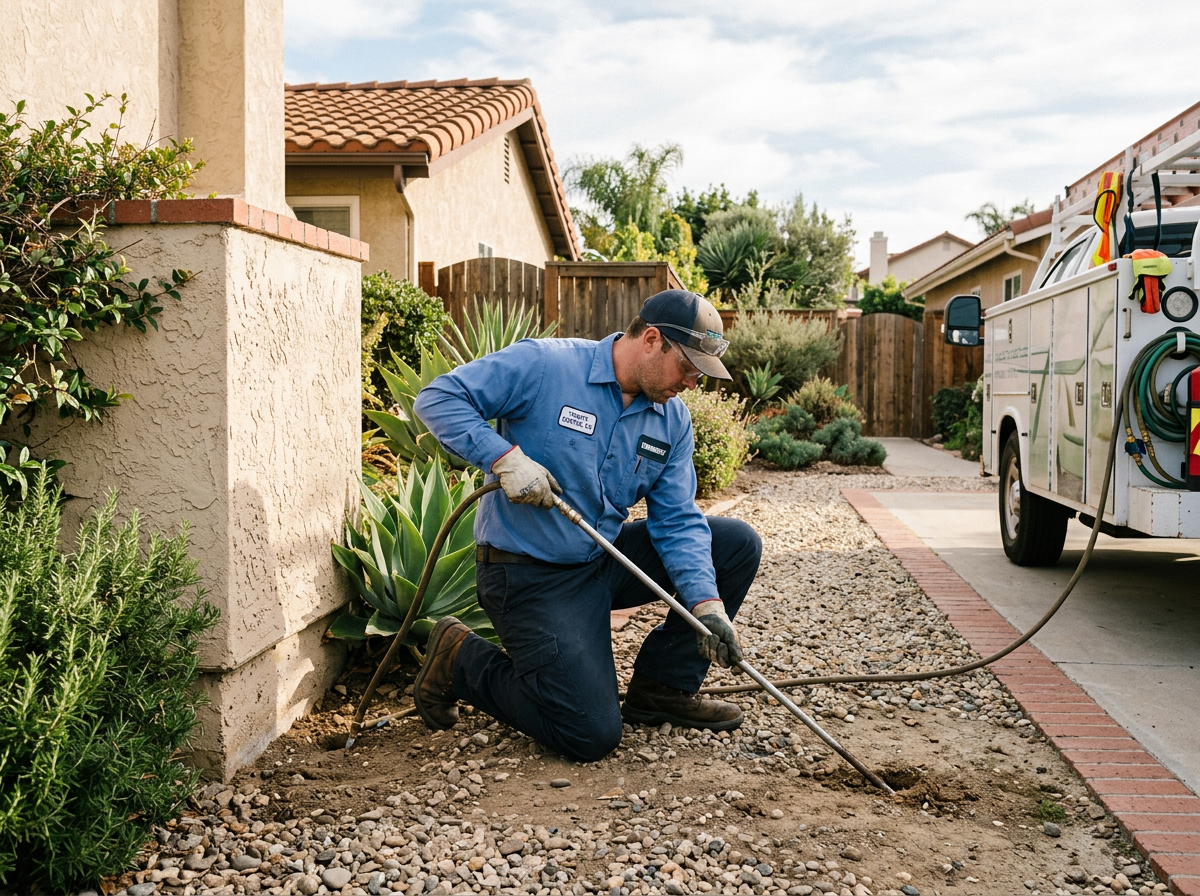
Anza properties range from older rural homes to newer builds scattered across the valley floor, with access often along longer driveways off CA-74 and CA-371. Seasonal dry periods mean crews pay close attention to any irrigation or plumbing features that create localized moisture.
Work in Anza requires travel from the Tehachapi base, so routes are planned to cover both central valley locations and outlying parcels efficiently while inspecting for the water-source patterns common in this high desert area.
Here's how our termite control work runs in Anza — the same standards we hold across California, delivered by the crew that covers Riverside County.
Termite Control Services We Offer in Anza
✓Species Identification Inspection
Technicians examine frass, mud tubes, kick-out holes, and wood damage to determine whether drywood or subterranean termites are present before any treatment begins.
✓Localised Spot Treatment
Borate or foam applications target drywood colonies inside individual wood members when evidence shows activity is limited to accessible areas.
✓Liquid Soil Barrier Installation
Trenching and rodding create a continuous treated zone around foundations, piers, and under slabs to interrupt subterranean termite access to moisture.
✓Baiting System Installation
Stations installed in soil around the structure allow ongoing monitoring and colony elimination for subterranean termites where liquid barriers are impractical.
✓Crawl Space Treatment
Foothill homes with dirt crawl spaces receive targeted inspection and treatment of piers, stem walls, and sill plates where both termite types commonly attack.
✓Conducive Conditions Correction
Technicians identify and document wood-to-soil contact, poor drainage, and moisture sources that allow subterranean termites to persist after initial treatment.
California properties face two distinct termite threats that require opposite approaches. Drywood termites remain inside structural wood with no soil contact, producing frass that appears as tiny hexagonal pellets beneath kick-out holes on coast and southern homes. Subterranean termites need constant soil moisture and build mud tubes along foundations, piers, and stem walls, especially in inland valleys and foothills like Tehachapi. Misidentifying the species leads directly to the wrong method and recurring damage.
Technicians begin every job by examining crawl spaces, attics, garages, and exterior grade for evidence that separates the two types. Once the species is confirmed, treatment follows the biology: localized borate or foam applications for drywood colonies inside single members, or a continuous liquid barrier created by trenching and rodding around the entire foundation plus beneath slabs and additions for subterranean colonies. Gaps in any barrier allow re-entry within months.
How It Works in Anza
- 1
Detailed Property Inspection
Technicians inspect crawl spaces, attics, garages, and exterior foundations for frass, mud tubes, kick-out holes, and active galleries.
- 2
Species Confirmation
Evidence collected determines whether drywood or subterranean termites are present and selects the matching treatment method.
- 3
Treatment Application
Spot treatments, trenching and rodding, or bait stations are applied according to the species and extent of activity found.
- 4
Follow-Up Monitoring
Return visits verify results and address any new activity or areas missed during the initial application.
Serving All of Anza
We regularly handle termite control jobs near:
- 📍Anza Community Park
- 📍Anza Valley
- 📍CA-74 corridor
- 📍CA-371 corridor
Termite Control Pricing in Anza
Scope depends on structure size, species found, and access conditions. Call for an inspection-based quote.
Want the full picture of this service? See our Termite Control page, or everything we do in Anza, CA.