
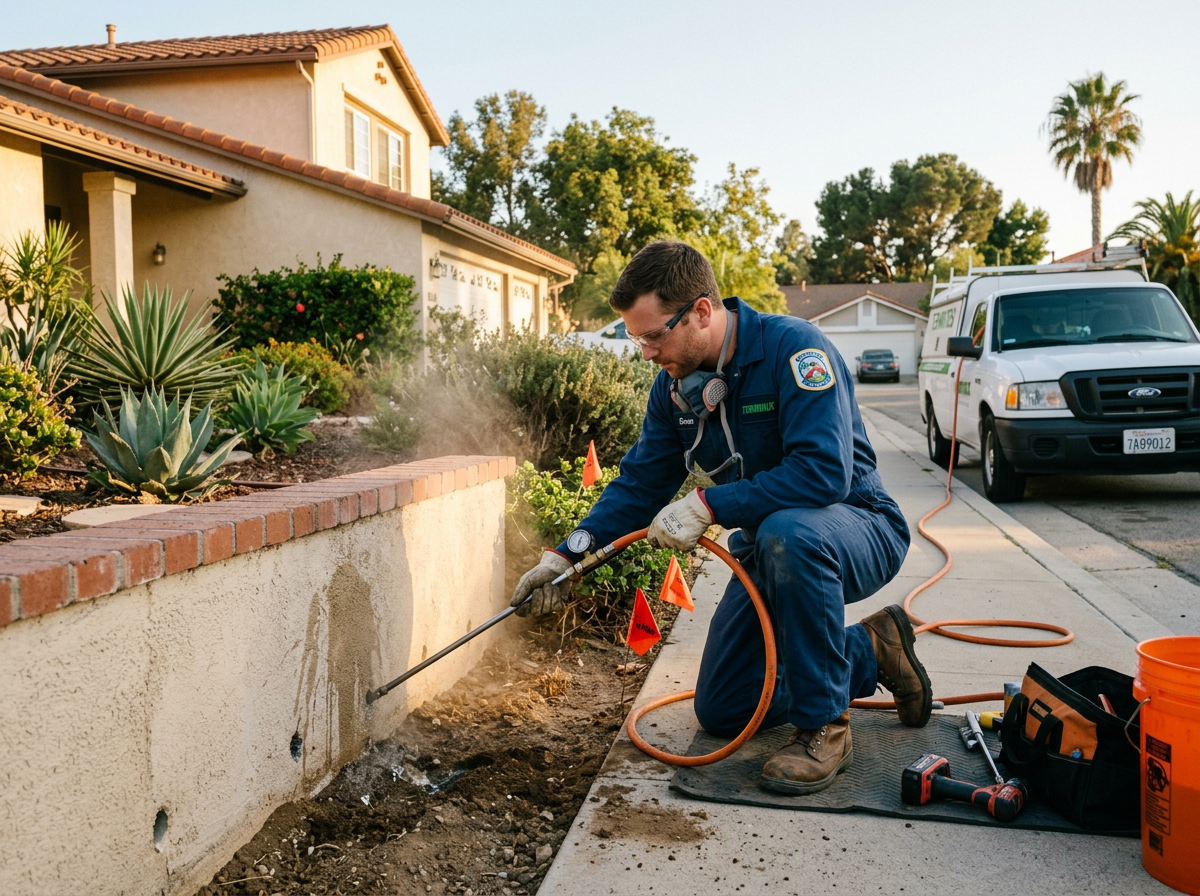
Bangor housing stock includes older rural homes with crawl spaces and timber framing set on dirt in the Sierra foothills. Seasonal rains and creek proximity create consistent moisture that draws subterranean activity toward foundations.
Access follows CA-99 into southern Butte County where technicians inspect wood-to-soil contact points common on local properties.
Here's how our termite treatment work runs in Bangor — the same standards we hold across California, delivered by the crew that covers Butte County.
Termite Treatment Services We Offer in Bangor
✓Species Identification Inspection
Technicians examine frass, mud tubes, galleries, and kick-out holes throughout the structure to determine whether drywood or subterranean termites are present before any treatment plan is created.
✓Localised Spot Treatment
Accessible drywood galleries receive targeted borate or foam applications directly into the wood members where colonies are confirmed, avoiding unnecessary whole-structure work when activity is limited.
✓Liquid Soil Barrier
A continuous trench is created around the foundation with rodding beneath slabs and additions to establish a soil treatment zone that interrupts subterranean termite access to the structure.
✓Baiting System Installation
Monitored bait stations are placed in the soil at intervals around the perimeter, allowing ongoing colony suppression for properties where trenching access is restricted or long-term monitoring is preferred.
✓Crawl Space Treatment
Dirt crawl spaces common in Tehachapi cabins receive thorough inspection and targeted barrier or wood treatment to address both species in areas that remain vacant for months.
✓Conducive Conditions Correction
Wood-to-soil contact, poor drainage, and debris under structures are identified and addressed to reduce future termite pressure after the initial treatment is complete.
California properties face both drywood and subterranean termites, and the two demand entirely different treatments. Drywood colonies live inside structural wood with no soil contact, leaving frass pellets near kick-out holes, while subterranean colonies require constant soil moisture and build mud tubes along foundations. A technician must first confirm which species is active through visual inspection of galleries, frass, and tubes before choosing between localized wood treatments or soil barriers. Misidentification leads to repeated failures because a spot treatment will not reach a subterranean colony and a soil barrier will not affect drywood inside timbers.
In Tehachapi foothill homes with dirt crawl spaces and older timber construction, undetected activity often spreads during long vacancy periods. Technicians examine joists, piers, stem walls, and attic members for active signs rather than relying on seller statements. Once species is confirmed, treatment follows the biology: borate or foam applications for accessible drywood galleries, or continuous trenching and rodding for subterranean barriers beneath slabs and additions. Gaps in any barrier or untreated wood sections allow re-entry, which is why full access and complete coverage matter more than product choice.
How It Works in Bangor
- 1
Initial Species Inspection
A technician inspects crawl spaces, attics, foundations, and exterior for frass, mud tubes, and galleries to confirm which termite type is active.
- 2
Treatment Plan Development
Based on findings, the correct method is selected: localized wood treatment for drywood or continuous soil barrier for subterranean activity.
- 3
Application and Access Work
Technicians complete trenching, rodding, or direct wood treatments, ensuring every identified active area receives full coverage.
- 4
Follow-Up Verification
Return visits confirm treatment effectiveness and check for any new activity that may require additional targeted work.
Serving All of Bangor
We regularly handle termite treatment jobs near:
- 📍CA-99 corridor
- 📍southern Butte County rural properties
- 📍creek beds near Bangor
- 📍farms and cabins off CA-99
Termite Treatment Pricing in Bangor
Scope depends on structure size, species present, and access conditions; pricing is provided after the inspection. Call to schedule.
Want the full picture of this service? See our Termite Treatment page, or everything we do in Bangor, CA.