
Landers properties sit on desert lots where water from irrigation or septic systems creates the main termite attractants. Crews travel CA-247 from Tehachapi and time visits around extreme summer heat.
Housing ranges from slab-on-grade homes to scattered structures near the earthquake fault, so access and treatment points focus on plumbing and shaded foundation edges rather than broad crawl spaces.
Below is what Landers customers get when they book subterranean termite control with us — local dispatch, and the exact process we use across California.
Subterranean termites in Tehachapi and similar foothill areas travel through soil to reach wood, leaving mud tubes along stem walls, piers and foundation edges that stay moist even when surface soil dries out. These colonies need constant ground moisture so they rarely appear above grade except during swarming or when tubes bridge treated zones. A missed tube or untreated expansion joint lets the colony bypass the barrier and continue feeding inside sill plates or subflooring for months before damage shows on an escrow inspection.
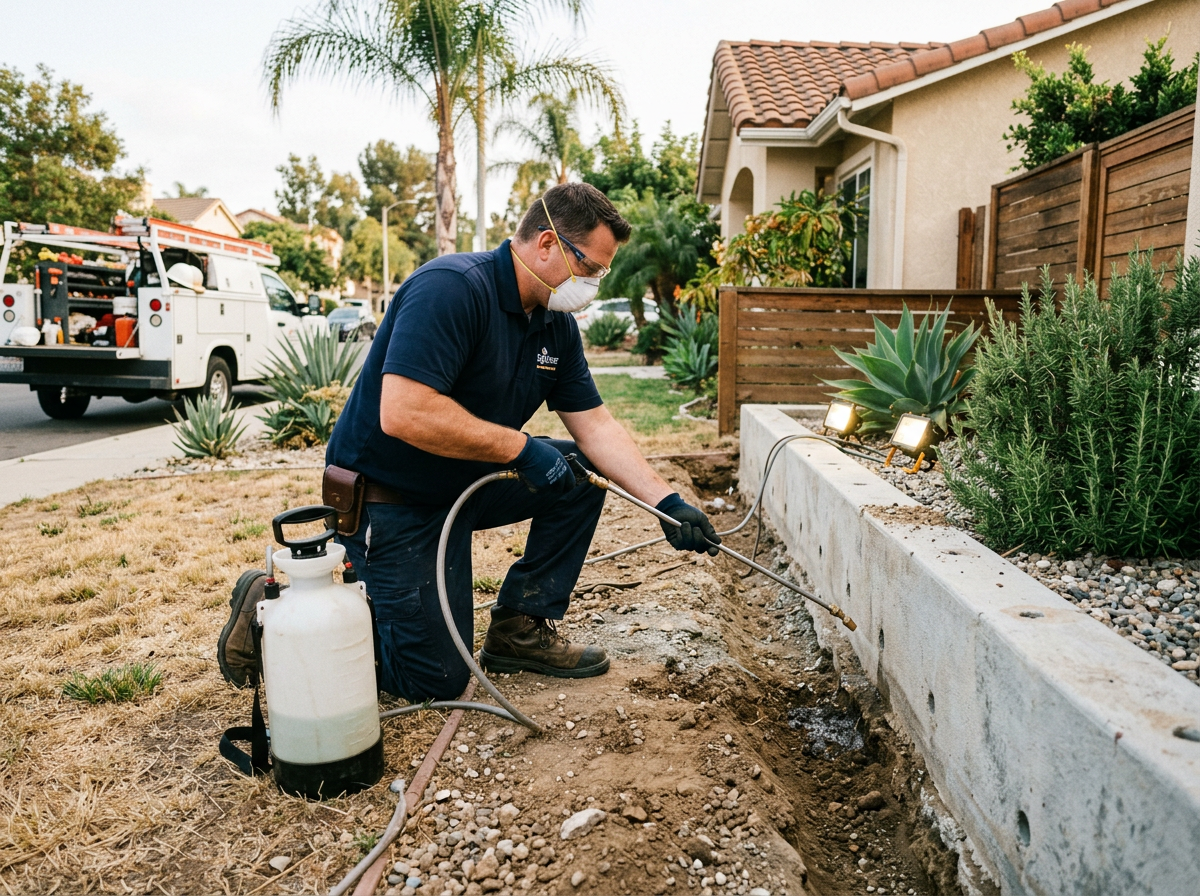
Treatment starts with trenching along the exterior foundation to a depth that reaches undisturbed soil, then rodding liquid termiticide under the slab edges and into the trench at labeled spacing. Additions, porches and dirt-filled crawl spaces receive separate drilling or rodding so the chemical forms an unbroken treated zone. Gaps occur where utilities enter, where old concrete meets new, or where landscaping soil has been piled against the house; those spots become the re-entry points on follow-up visits.
Subterranean Termite Control Services We Offer in Landers
✓Mud Tube Inspection
Technicians trace and document every mud tube on foundations, piers and stem walls to confirm active subterranean termite foraging before any treatment begins.
✓Trenching and Rodding
A continuous trench is dug around the structure and rodded with termiticide to create an unbroken soil barrier that blocks colony access from below grade.
✓Slab and Addition Treatment
Drilling and rodding beneath concrete slabs, patios and room additions ensures termiticide reaches soil under areas where trenching alone cannot reach.
✓Crawl Space Treatment
Dirt crawl spaces common in foothill cabins receive perimeter trenching plus treatment of interior piers and any visible tubes to close off hidden travel routes.
✓Conducive Conditions Correction
Advice on lowering soil grade, fixing irrigation leaks and clearing wood debris that keeps the area attractive to subterranean colonies after the barrier is installed.
How It Works in Landers
- 1
Detailed Site Inspection
Technician maps all mud tubes, checks moisture around the foundation, and notes any additions or crawl space access points.
- 2
Trench Preparation
Soil is excavated to proper depth along the perimeter while protecting plants and irrigation lines that run near the foundation.
- 3
Rodding And Application
Termiticide is applied by rodding under slabs and pouring into the trench to form a continuous treated zone without skips.
- 4
Post-Treatment Review
Tubes are removed, treated areas are documented, and any remaining conducive conditions are pointed out to the homeowner.
Serving All of Landers
We regularly handle subterranean termite control jobs near:
- 📍Giant Rock
- 📍Integratron
- 📍Landers Earthquake Fault
Subterranean Termite Control Pricing in Landers
Scope depends on foundation length, number of additions, crawl space access and whether bait stations are added; call for an inspection-based quote.
Want the full picture of this service? See our Subterranean Termite Control page, or everything we do in Landers, CA.