
Subterranean termites in Tehachapi and similar foothill areas travel through soil to reach wood, leaving mud tubes along stem walls, piers and foundation edges that stay moist even when surface soil dries out. These colonies need constant ground moisture so they rarely appear above grade except during swarming or when tubes bridge treated zones. A missed tube or untreated expansion joint lets the colony bypass the barrier and continue feeding inside sill plates or subflooring for months before damage shows on an escrow inspection.
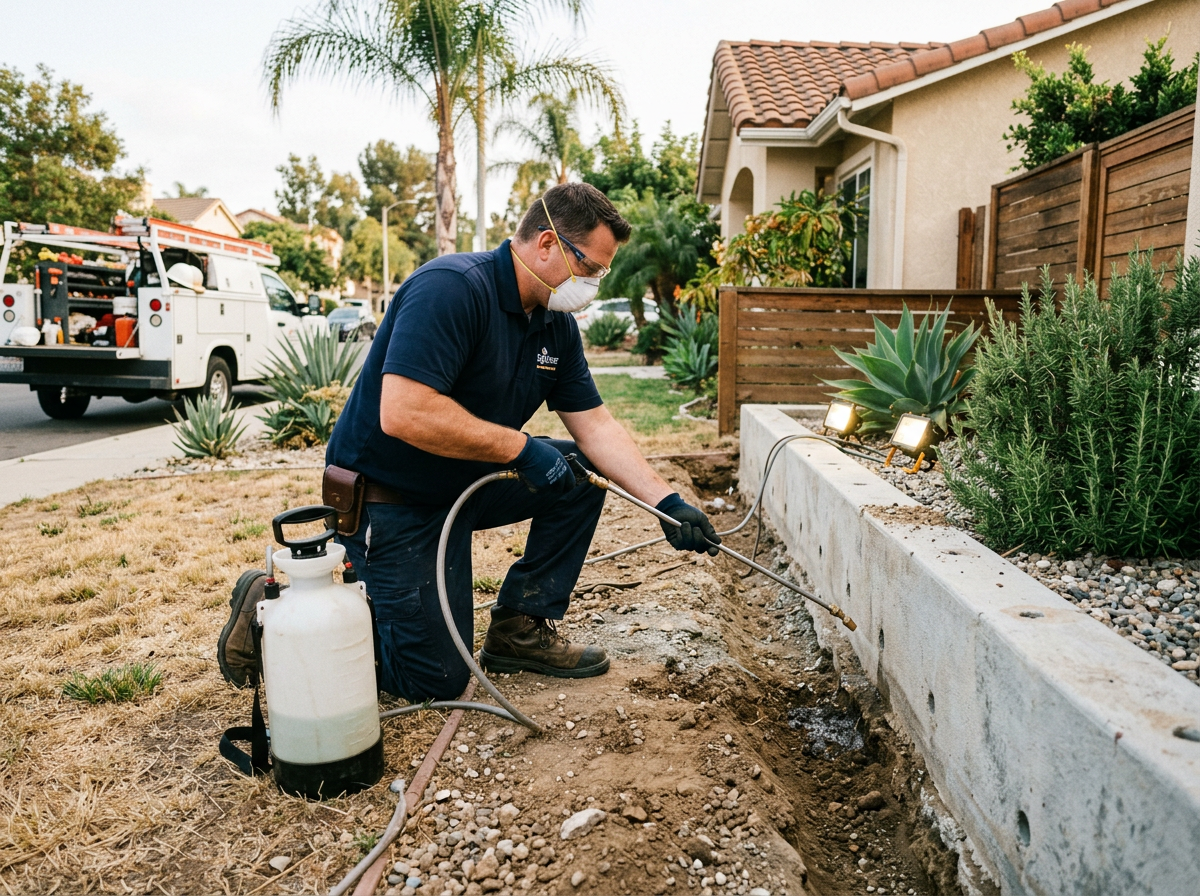
Treatment starts with trenching along the exterior foundation to a depth that reaches undisturbed soil, then rodding liquid termiticide under the slab edges and into the trench at labeled spacing. Additions, porches and dirt-filled crawl spaces receive separate drilling or rodding so the chemical forms an unbroken treated zone. Gaps occur where utilities enter, where old concrete meets new, or where landscaping soil has been piled against the house; those spots become the re-entry points on follow-up visits.
Subterranean Termite Control Near You — Choose Your City
Every city below has its own local Subterranean Termite Control page with coverage details.
Mono County
Butte County
Kern
Fresno County
Plumas County
Kern County
Yuba County
Inyo County
Placer County
Sutter
Tuolumne County
Tulare
Calaveras County
Mariposa
Alameda
Mariposa County
Amador County
Nevada County
Sierra County
Plumas
Riverside
San Bernardino County
Sonoma
San Diego County
Riverside County
Sonoma County
Marin County
Glenn County
San Bernardino
Los Angeles County
San Diego
Tulare County
Mendocino
Yolo County
Monterey County
Madera County
Even a complete barrier can be compromised by future irrigation changes, new construction next door, or heavy rains that erode the treated soil line. Homeowners in older Tehachapi cabins often discover the issue only when a Section 1 report flags active tubes during sale. Retreatment focuses on restoring continuity rather than guaranteeing the original colony is gone, and properties with repeated moisture issues may need ongoing bait stations in addition to the liquid application.
Technician insight
In Tehachapi the thing that catches most people out with Subterranean Termite Control is how 1960s and 70s cabins on dirt crawl spaces sit on shallow footings with no vapor barrier, so even a perfect perimeter barrier can be bypassed when winter rains push moisture under the unlined slab edges.
Tehachapi Cabin Foundation Breach
Mud tubes appeared along the north stem wall after heavy rain. Inspection found an untreated gap where a 1980s room addition met the original footing. Trenching and rodding restored the barrier around the entire perimeter and under the addition, closing the entry route.
Subterranean Termite Control Services We Offer
✓Mud Tube Inspection
Technicians trace and document every mud tube on foundations, piers and stem walls to confirm active subterranean termite foraging before any treatment begins.
✓Trenching and Rodding
A continuous trench is dug around the structure and rodded with termiticide to create an unbroken soil barrier that blocks colony access from below grade.
✓Slab and Addition Treatment
Drilling and rodding beneath concrete slabs, patios and room additions ensures termiticide reaches soil under areas where trenching alone cannot reach.
✓Crawl Space Treatment
Dirt crawl spaces common in foothill cabins receive perimeter trenching plus treatment of interior piers and any visible tubes to close off hidden travel routes.
✓Conducive Conditions Correction
Advice on lowering soil grade, fixing irrigation leaks and clearing wood debris that keeps the area attractive to subterranean colonies after the barrier is installed.
How it works
- 1
Detailed Site Inspection
Technician maps all mud tubes, checks moisture around the foundation, and notes any additions or crawl space access points.
- 2
Trench Preparation
Soil is excavated to proper depth along the perimeter while protecting plants and irrigation lines that run near the foundation.
- 3
Rodding And Application
Termiticide is applied by rodding under slabs and pouring into the trench to form a continuous treated zone without skips.
- 4
Post-Treatment Review
Tubes are removed, treated areas are documented, and any remaining conducive conditions are pointed out to the homeowner.
Pricing
Scope depends on foundation length, number of additions, crawl space access and whether bait stations are added; call for an inspection-based quote.